Kitchens are designed for adults. The counters are high, the tools can be dangerous, and ingredients are stored out of reach. Most recipes are also designed for adults. They use unfamiliar, technical vocabulary, they are written in long paragraphs, and they make assumptions about years of prior cooking experience.
It’s no wonder so many parents are apprehensive about letting their kids cook. And it isn’t just because of safety. Looking ahead at the task, it often feels like cooking with kids will require constant supervision, endless questions, an unavoidable mess, and a lot of extra work.
As a learning designer—someone who writes curriculum, assessments, and learning materials professionally—I look at the kitchen differently. Rather than asking, why can’t the learner do this? I ask, what’s getting in their way?
Learning designers call these obstacles barriers. They can be physical, cognitive, emotional, or a mixture of all three. My job is to identify those barriers and either remove them, reduce their prominence, or give the learner tools to overcome them.
This way of thinking is at the heart of Universal Design for Learning (UDL), an educational framework built around the idea that learning environments should be designed to support the natural variability of learners. Instead of expecting every learner to adapt to the environment, UDL asks how we can adapt the environment to better support the learner.
Imagine a building with an entrance at the top of a set of stairs. If someone using a wheelchair can’t get inside, we don’t conclude that the person is the problem. We recognize that the building creates the barrier. Adding a ramp doesn’t change the person; it changes the environment.
The same idea applies to learning. If a child is struggling to grasp a new concept, it doesn’t necessarily mean that they lack the ability to understand it. Sometimes the task or the teaching simply wasn’t designed with them in mind.
Teachers already do this in schools all the time. Audiobooks, larger print, graphic organizers, sentence starters, speech-to-text, visual schedules, calculators, pencil grips, extra processing time, and breaking work into smaller chunks are all examples of reducing barriers so learners can access the same learnings.
The kitchen deserves the same kind of thinking.
Let’s stop asking, why can’t my kid cook independently? And instead ask, what barriers are getting in the way?

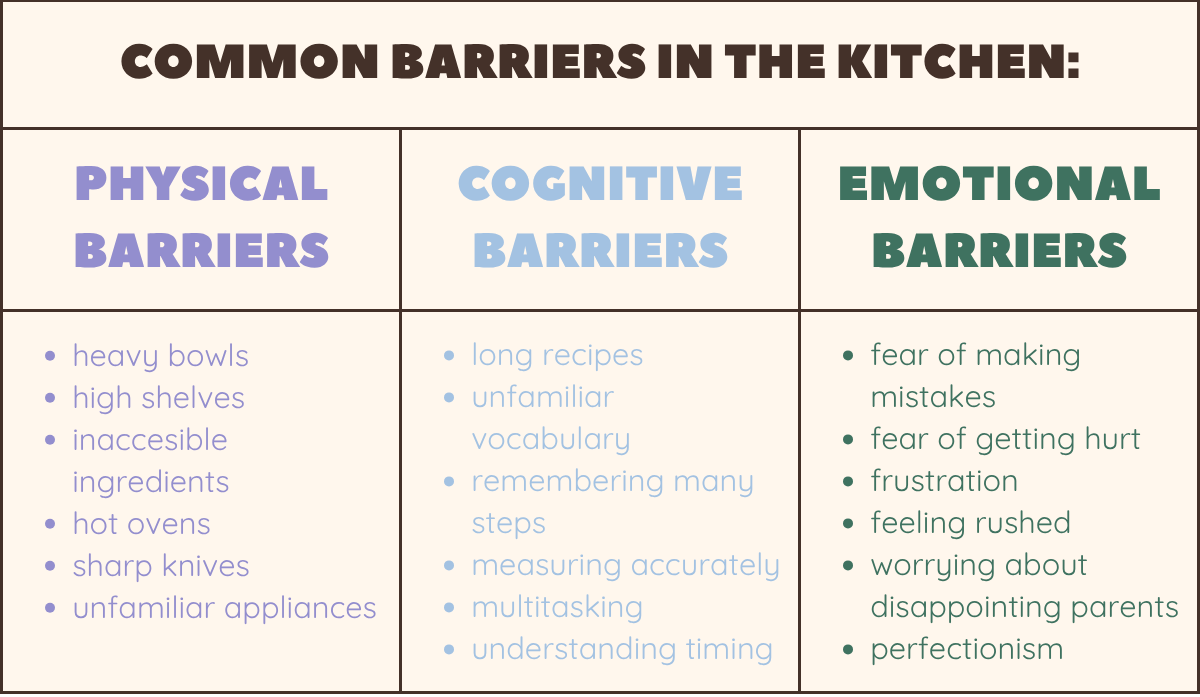
Every kid—and every adult, for that matter—will experience different barriers. The goal isn’t to eliminate every challenge. It’s to notice what’s getting in the way so you can reduce the obstacles and find solutions to help overcome those barriers.
Here are a few examples.
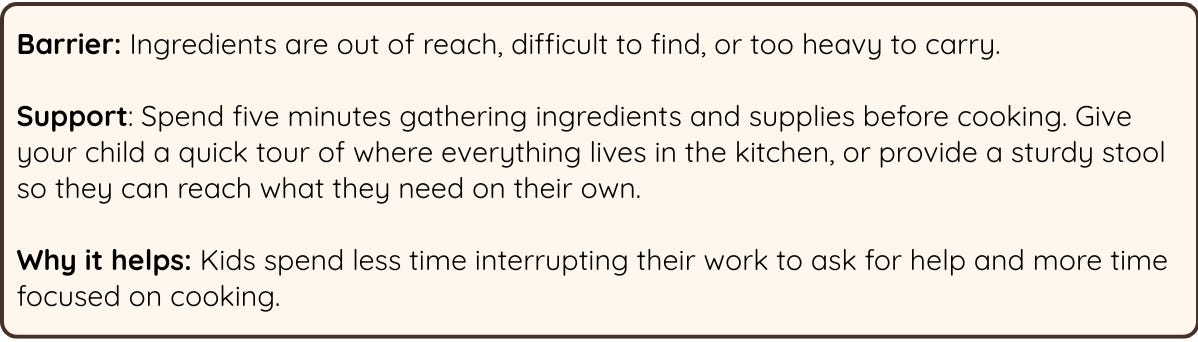
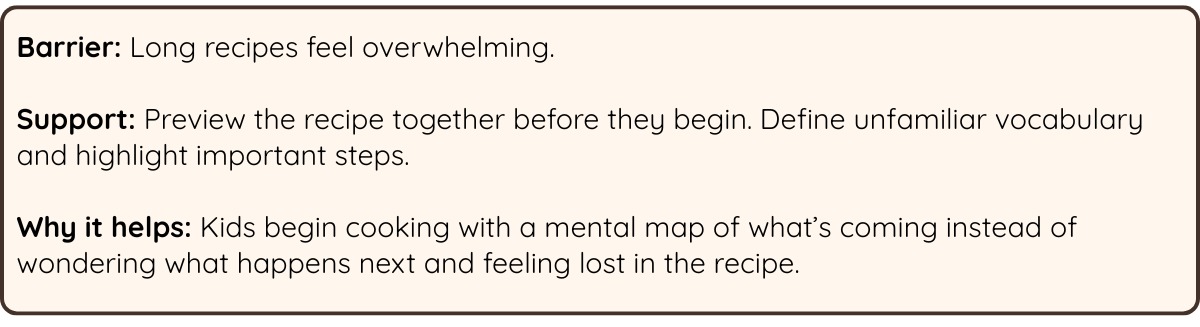
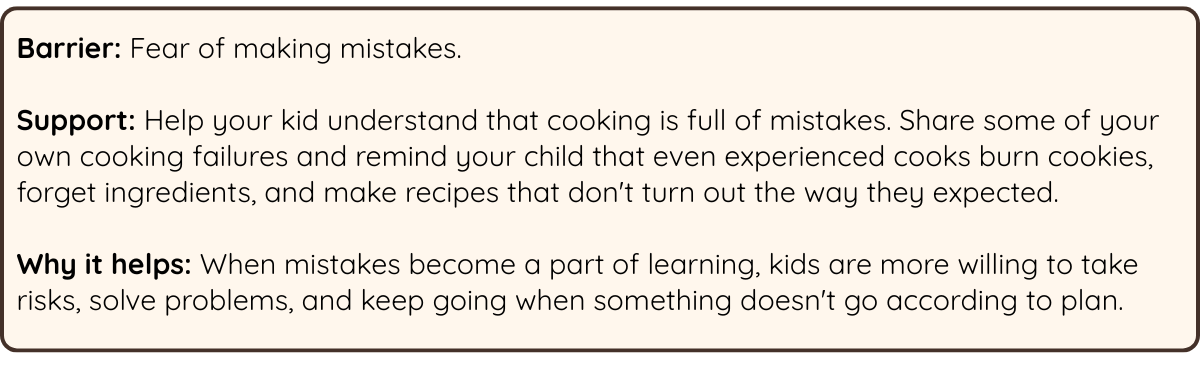
Barrier Reduction in Action
Every Nibblings recipe is designed with the recurring question of what could make this recipe, this step, this process, this experience unnecessarily difficult for a kid, and then I design to reduce the barrier wherever possible. Some examples of how I’ve done this are:
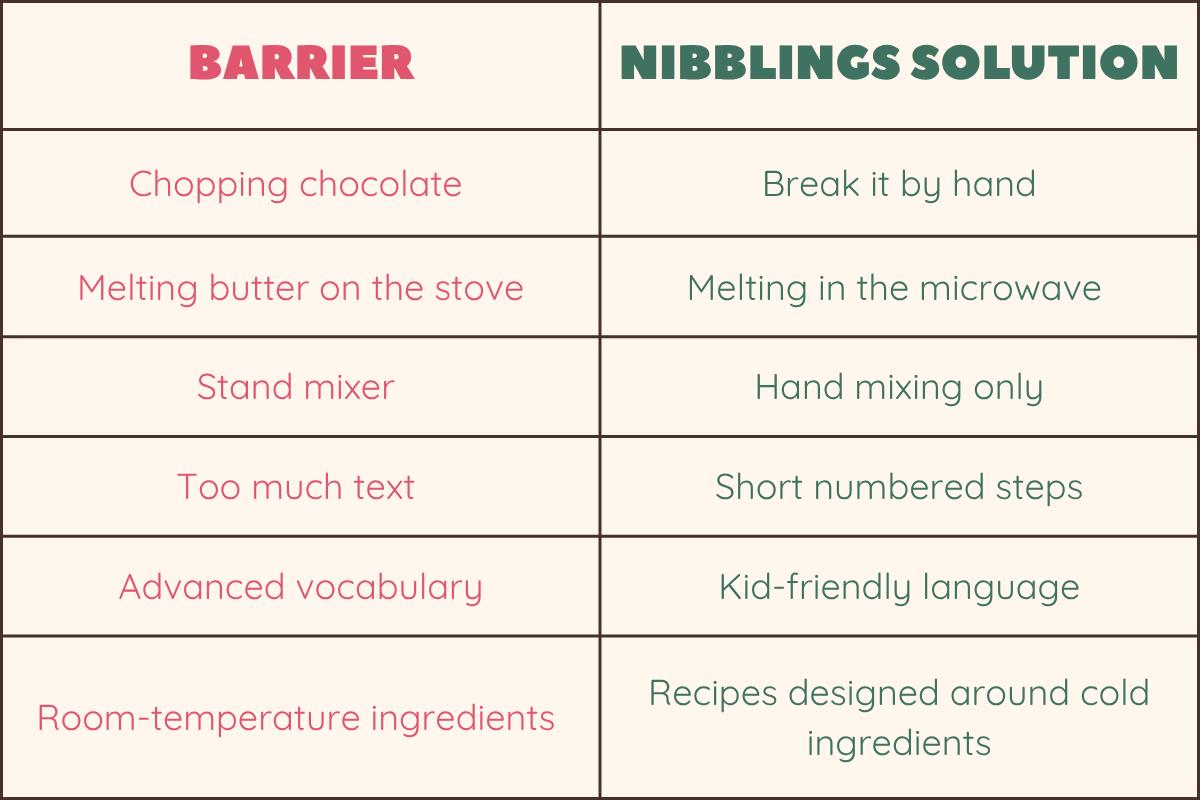
Reducing barriers isn’t about making cooking easy. It’s about making cooking accessible.
Kids still have to solve problems, and they will still make mistakes. They still practice planning, patience, persistence, flexibility, and critical thinking. Those challenges are where the learning happens.
The goal isn’t to remove the hard parts. It’s to remove the parts that make learning harder and not better.
When kids spend less energy fighting unnecessary obstacles, they have more energy to devote to the meaningful work of learning.
That’s the philosophy behind every Nibblings recipe: not to remove the challenge, but to remove the barriers that prevent kids from rising to the challenge.